
Introduction :
Lung volumes and capacities represent measurable indicators that quantitatively describe the respiratory system’s mechanical properties and functional capabilities. These measures offer factual data points that are essential for establishing a baseline of respiratory performance.
Fundamental lung volumes : The building blocks of respiration
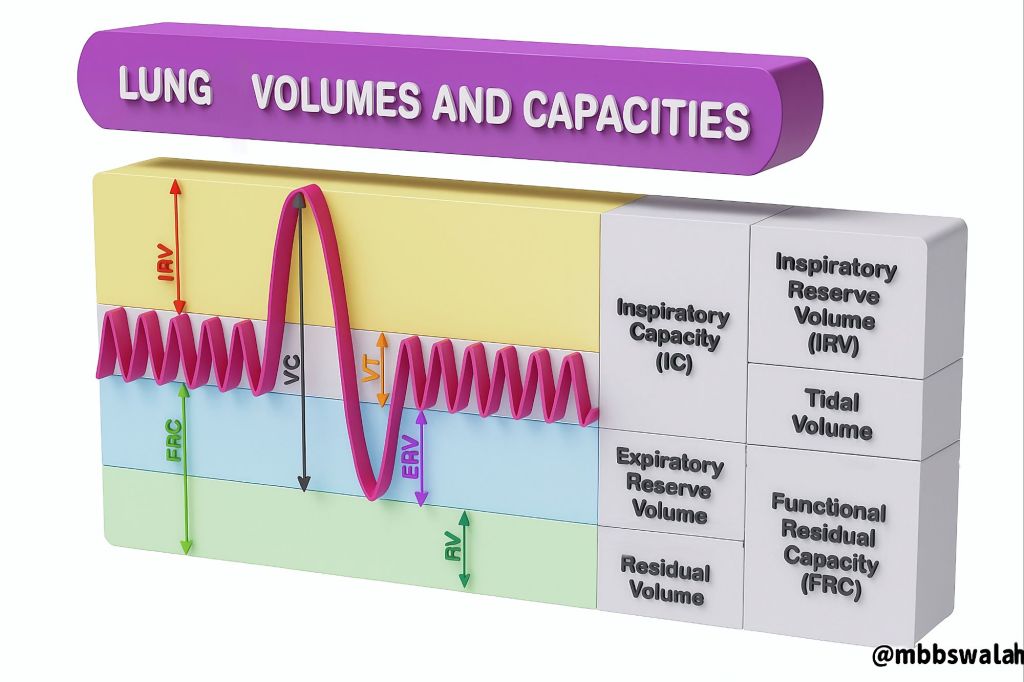
Lung volumes are often referred to as respiratory volumes. They are distinct quantities of gas present in the lungs at specific phases of the respiratory cycle. These volumes are dynamic. They exhibit considerable variation based on individual characteristics. These characteristics include depth of respiration, ethnicity, gender, age, and body composition.
- Tidal Volume (TV)
- Inspiratory Reserve Volume (IRV)
- Expiratory Reserve Volume (ERV)
- Residual Volume (RV)
| Volumes | Definition | Typical Adult Value | Key Clinical Note |
| Tidal Volume (TV) | Amount of air inhaled or exhaled during one normal,resting respiratory cycle. | 300-500 mL (6-8mL/kg) | Reflects baseline breathing and respiratory muscle function. |
| Inspiratory Reserve Volume (IRV) | Maximum amount of air that can be forcibly inhaled beyond a normal tidal inspiration. | – | Used during deep breathing or exertion. |
| Expiratory Reserve Volume(ERV) | Maximum amount of air that can be forcibly exhaled after a normal tidal expiration. | – | Volume expelled from FRC to RV. |
| Residual Volume(RV) | Amount of air remaining in the lungs after a maximal exhalation. | – | Cannot be measured by spirometry;requires specialized techniques. |
Lung Capacities:
Lung capacities are not fundamental or directly measured volumes. Instead, they are functional combinations. These combinations are formed by the summation of two or more primary lung volumes. These capacities provide a more comprehensive assessment of the lung’s overall functional capabilities.
- Inspiratory Capacity (IC)
- Functional Residual Capacity (FRC)
- Vital Capacity (VC)
- Total Lung Capacity (TLC)
| Capacities | Definition | Formula | Typical Adult Value | Key Clinical Note |
| Inspiratory Capacity (IC) | Maximum volume of air that can be inhaled following a normal resting expiration. | IC = IRV + TV | – | Reduced in obstructive lung diseases. |
| Functional Residual Capacity (FRC) | Amount of air remaining in the lungs at the end of a normal, quiet exhalation. | FRC = RV + ERV | 1800-2200 mL | Lung’s resting position; reduced in restrictive,elevated in obstructive diseases. |
| Vital Capacity(VC) | Total amount of air that can be exhaled after a maximal inhalation. | VC = TV + IRV +ERV | ~4800 mL | Indicates ability to breathe deeply and cough; reflects muscle strength. |
| Total Lung Capacity (TLC) | Maximum volume of air the lungs can accommodate after a maximal inspiration. | TLC = TV + IRV +ERV + RV | 4-6 L (6000 mL) | Increased in obstructive(hyperinflation),decreased in restrictive diseases. |
Pulmonary Function Tests (PFTs):
- Spirometry
- Plethysmography
- Diffusion Test
Spirometry :
Spirometry is the most commonly performed type of PFT. It measures the amount of air a person can exhale. It also measures the speed at which they can empty air from their lungs.
Plethysmography:
This method is considered the most accurate. It is the gold standard for measuring absolute lung volumes. These include Total Lung Capacity (TLC) and Residual Volume (RV). This technique is particularly valuable for identifying abnormalities of overall lung size and detecting air trapping.
Diffusion Test :
The DLCO test measures how efficiently gas is transferred from the air in the alveoli into the pulmonary capillaries. It then examines how it subsequently moves into the blood. The procedure requires the patient to inhale a harmless tracer gas mixture. This typically contains a small, known amount of carbon monoxide and methane. The inhalation lasts for a very short period, often just a single breath hold of 8-10 seconds.
| Parameter | measurement types | What it Measures | Indication |
| Forced Vital Capacity (FVC) | Spirometry | Total amount of air exhaled forcefully after maximal inspiration. | Reduced in both obstructive and restrictive diseases. |
| Forced Expiratory Volume in 1 second (FEV1) | Spirometry | Volume of air exhaled in the first second of a forced exhalation. | Decreased in obstructive diseases; can be decreased in restrictive diseases. |
| FEV1 / FVC Ratio | Spirometry | Ratio of FEV1 to FVC. | Primary indicator for distinguishing obstructive (< normal)from normal/restrictive(normal/increased)patterns |
| Total Lung Capacity(TLC) | Plethysmo-graphy / Gas Dilution | Total volume of air in the lungs after maximal inspiration. | Increased in obstructive(hyperinflation);decreased in restrictive diseases. |
| Residual Volume (RV) | Plethysmo-graphy / Gas Dilution | Air remaining in lungs after maximal exhalation. | Increased in obstructive(air trapping); can be decreased in restrictive diseases. |
| Functional Residual Capacity (FRC) | Plethysmography / Gas Dilution | Air remaining in lungs after normal exhalation. | Increased in obstructive; decreased in restrictive diseases. |
| Diffusing Capacity of the Lung for Carbon Monoxide (DLCO) | Gas Diffusion Test | Efficiency of gas transfer from lungs to blood. | Decreased in emphysema, interstitial lung disease ,pulmonary vascular disease; normal/ increased in asthma. |
| Fractional Exhaled Nitric Oxide (FeNO) | Special Test | Level of air way inflammation. | Elevated in asthma;used for diagnosis and monitoring inflammatory air way diseases. |
| Cardio pulmonary Exercise Test (CPET) | Special Test | Lung and heart function during physical activity. | Assesses exercise limitation, oxygen needs, and functional capacity. |


 MBBSWALAH
Leave a comment